



Hiring is part of running a growing business, but that does not mean every company has the time or resources to manage recruitment on its own.
Writing job descriptions, promoting open roles, reviewing applications, screening candidates, conducting interviews, and completing onboarding all take time. For a small or mid-sized business without a dedicated talent acquisition team, that work often falls to an owner, manager, administrator, or HR professional who already has a full workload.
There are also times when traditional hiring does not match the needs of the business. You may need 20 additional workers for a seasonal rush, someone to cover a three-month leave, or qualified candidates for a role that has been sitting open for weeks.
These are some of the situations where a staffing agency can help.
A staffing agency acts as an extension of your team. Depending on the type of service you choose, it can help recruit, screen and onboard candidates or provide temporary employees who are employed by the agency while working on assignment at your company. Specific employment, health and safety and licensing requirements can vary by province, making it important to work with a staffing partner that understands the requirements where your company operates.
Understanding when to use a staffing agency can help you decide whether outsourcing some or all of your hiring process makes sense for your business.
In this guide, we’ll cover:
- When it makes sense to use a staffing agency and when hiring directly may be a better fit.
- The benefits of using a staffing agency, including access to candidates, flexibility and reduced recruiting workload.
- How temporary staffing can affect hiring costs, payroll administration and compliance responsibilities.
- When temp-to-hire may make sense for a potential permanent position.
- What to look for when choosing a staffing agency.
- How temporary, temp-to-hire and direct-hire recruitment support different hiring needs.
When Should You Use a Staffing Agency?
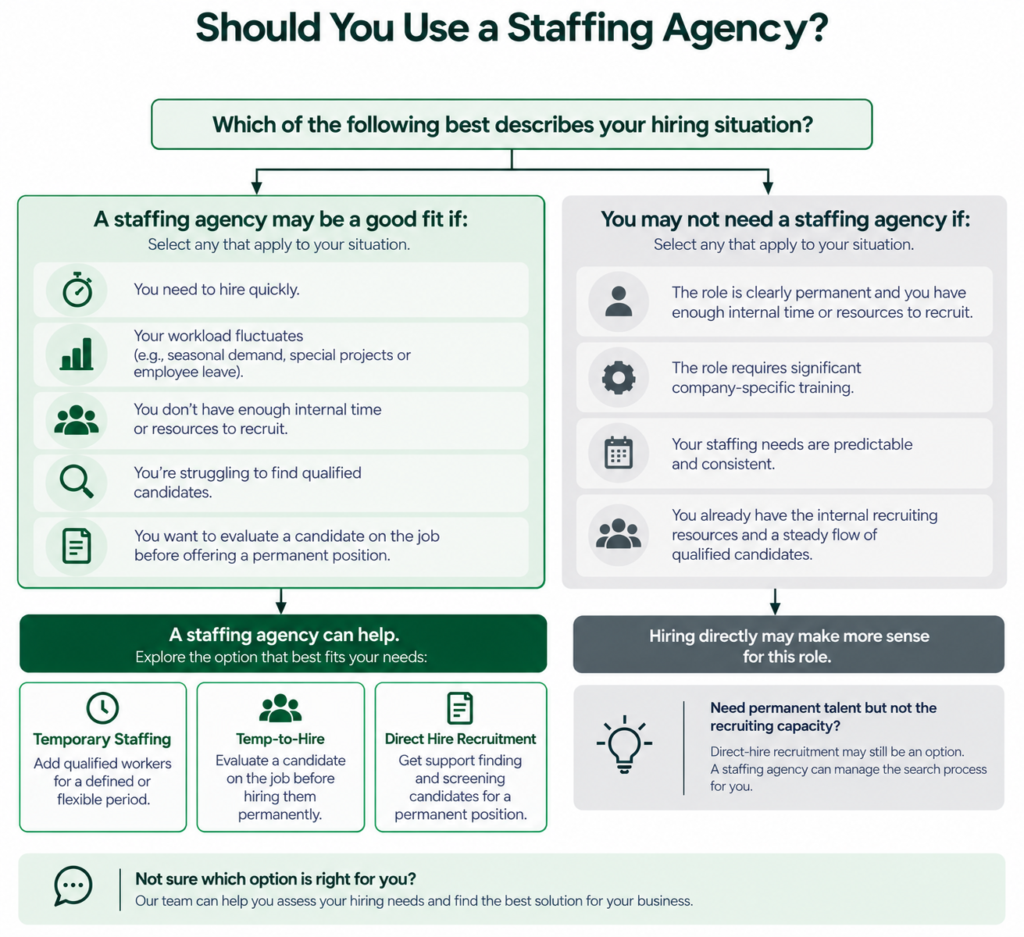
You do not need to outsource every hire. If your company has a strong internal recruitment team, a steady flow of qualified applicants, and predictable staffing needs, handling recruitment internally may make sense.
A staffing agency becomes more useful when your hiring needs start competing with your ability to run the rest of the business.
You need to hire quickly
An unexpected resignation, large order, or new project can leave you with more work than your existing team can handle.
Hiring directly takes time. Someone needs to advertise the opening, review applications, contact candidates, arrange interviews, and complete the required paperwork. The faster you need someone, the harder it can be to complete each step without taking time away from other priorities.
A staffing agency already has recruitment systems and candidate pipelines in place. That can give companies another way to find people without building a new recruitment campaign every time a need appears.
This can be especially useful when you need to hire someone for a short-term project or fill several positions at once.
Your workload changes throughout the year
Not every business needs the same number of employees year-round.
Manufacturers may have production peaks. Warehouses and distribution centres may need more workers when order volume rises. Retail and service businesses may experience seasonal demand. Other companies may need short-term support for a special project, employee leave, or unexpected absence.
In these situations, hiring permanent employees based on your busiest period can leave you overstaffed when demand falls.
One option is a baseline staffing model. Your company maintains the permanent workforce needed for normal operations, then uses temporary employees when demand rises.
This gives you the ability to add capacity without assuming that the higher staffing level will be needed all year.
It can also help control overtime. Instead of repeatedly asking your existing employees to work longer hours during a surge, temporary staff can add capacity where it is needed. This may be particularly useful when high workloads are expected to last weeks or months rather than becoming a permanent part of operations.
Your team does not have enough time for recruiting
For a company without an internal recruiter, hiring can quickly become another job.
Managers may find themselves reviewing resumes after hours. HR staff may spend more time scheduling interviews than handling their other responsibilities. Business owners may lose hours speaking with candidates who do not meet the basic requirements.
A staffing agency can take over some of that workload. Depending on the arrangement, this can include advertising positions, reviewing applications, screening candidates, checking qualifications and references, co-ordinating interviews, and helping with onboarding.
That frees your internal team to focus on the candidates who are most likely to meet the role requirements rather than managing every stage of the applicant funnel.
When Should You Not Use a Staffing Agency?
A staffing agency is not the right solution for every hiring need. Before choosing temporary staffing, consider how long you expect to need the employee, how consistent the workload is and whether the position is part of your long-term workforce plan.
Temporary staffing may not be the best fit when:
- You know the position is permanent. If you have an ongoing need for a full-time employee and expect the role to remain part of your team, hiring permanently from the start may make more sense.
- The role requires significant long-term training. Some positions take months to learn. If the value of the employee grows with company-specific knowledge and experience, investing in a permanent hire may be a better option.
- You are hiring for a senior or highly specialized position. Leadership, management and some professional roles may require a more targeted recruitment process rather than a temporary staffing model.
- Your staffing needs are predictable and consistent. If you know you need the same number of employees throughout the year, maintaining the right permanent workforce may be more practical than regularly filling those positions with temporary workers.
- You have the internal resources to recruit effectively. Companies with a dedicated talent acquisition team, strong candidate pipeline and enough time to manage recruitment may not need to outsource routine hiring.
However, deciding against temporary staffing does not necessarily mean a staffing or recruitment agency cannot help.
Some staffing agencies also offer direct-hire recruitment, where the agency helps you find and screen candidates for a permanent position. The successful candidate then becomes your employee rather than an assignment employee of the staffing agency.
This can be useful when you know you need a permanent employee but do not have the time, candidate network or internal recruiting resources to find that person yourself.
For example, a business may use direct-hire recruitment when it needs a specialized professional, manager, or other permanent employee but is struggling to generate qualified applicants through its usual job postings.
The key is choosing the hiring model that fits the position and your long-term business needs.
What Are the Benefits of Using a Staffing Agency?
The benefits of staffing agencies extend beyond filling an empty position. The right arrangement can give a business more flexibility while reducing the amount of internal time spent managing recruitment.
Access a larger candidate pool
Posting a job does not guarantee that the right person will see it.
A staffing agency recruits on an ongoing basis rather than only when one company has an opening. This can give it an existing network of candidates, referrals, and past applicants to draw from.
That matters when job boards are producing plenty of applications but few qualified candidates.
It can also help when you are trying to reach people who may be open to a new opportunity but are not actively checking job boards every day.
For hard-to-fill roles, the advantage is not simply having access to more resumes. A staffing partner can help identify which skills are essential, screen for those requirements, and focus recruitment efforts on candidates who are more likely to fit the position.
Canada’s labour market has changed since job vacancies reached record levels in 2022. According to Statistics Canada’s Job Vacancy and Wage Survey for the second quarter of 2026, there were 510,200 job vacancies across Canada. While the proportion of long-term vacancies has fallen from its 2022 peak, hiring conditions continue to differ by occupation and the level of education required. For example, vacancies increased year over year in trades, transport, and equipment operator occupations as well as manufacturing and utilities.
Reduce the time your team spends on hiring
There is a cost to recruitment even when you never receive an invoice for it.
Consider how many hours your team spends creating a job posting, managing ads, reviewing resumes, contacting applicants, interviewing candidates, checking references, and preparing a new employee.
Those hours have an opportunity cost. A manager who spends an afternoon reviewing applications is not spending that afternoon on operations, customers, strategy, or their team.
A staffing agency shifts much of that work outside your organization.
This does not mean your company has no role in hiring. You still need to communicate what makes someone successful in the position and, depending on the service, may participate in the final selection. The difference is that your team does not necessarily have to manage every applicant or administrative step along the way.
Add flexibility without over-hiring
Suppose your company needs 15 additional workers for the next three months.
Hiring 15 permanent employees may not make sense if you know demand will return to normal. Asking your existing staff to absorb all of the extra work may not be sustainable either.
Temporary staffing provides another option.
In a typical temporary staffing arrangement, the staffing agency employs workers and assigns them to perform work at a client company. The exact legal relationship and responsibilities can vary by province. For example, under Ontario’s Employment Standards Act, a temporary help agency is the employer of its assignment employees.
This model can help companies scale their workforce up or down as business needs change.
Can a Staffing Agency Help Reduce Hiring Costs and Risk?
One of the common questions companies ask is whether using temporary staff is cheaper than hiring full-time employees.
There is no universal answer.
A temporary employee comes with an agency bill rate, so comparing that rate only with the hourly wage of a permanent employee does not give you the full picture. Companies should look at the total cost and the business needs.
For a permanent hire, costs can include advertising, internal recruiting time, payroll administration, onboarding, benefits where applicable, and the cost of starting over if the employee leaves or is not the right fit.
Temporary staffing can make financial sense when the alternative is carrying unnecessary permanent headcount, paying significant overtime, or using management time to repeatedly recruit for short-term needs.
The goal should not simply be to find the lowest hourly cost. It should be to choose the staffing model that fits the length, predictability and requirements of the work.
What about payroll and employment administration?
Temporary staffing can also move some employment administration away from your internal team.
Depending on the staffing arrangement and province, the agency may handle responsibilities such as payroll, statutory deductions and other employment administration for its temporary employees. However, working with an agency does not remove every responsibility from the company where the work is performed.
Health and safety is one important example, and requirements vary across Canada.
In Alberta, occupational health and safety legislation outlines specific responsibilities for temporary staffing agencies. These include ensuring an assigned worker is suitable for the required tasks, making sure necessary personal protective equipment is provided, and confirming that the company receiving the worker is capable of protecting their health and safety.
In British Columbia, WorkSafeBC provides guidance on the responsibilities of labour supply firms and the companies that use their workers. WorkSafeBC recognizes the labour supply firm as the direct employer while also identifying responsibilities for the company that operates the workplace and directs the work.
Ontario provides another example of how provincial requirements can differ. Since July 1, 2024, temporary help agencies and recruiters have been required to hold a provincial licence. Companies in Ontario are prohibited from knowingly using an unlicensed temporary help agency.
The requirements are not identical from one province to another. This is one reason it is important to work with a staffing partner that understands the employment, payroll, health and safety, and other compliance requirements that apply where your employees will work.
When Does Temp-to-Hire Make Sense?
Sometimes the challenge is not finding someone for a temporary need. It is deciding whether a candidate will work out as a permanent member of your team.
That is where temp-to-hire can be useful.
With a temp-to-hire arrangement, a candidate starts as an employee of the staffing agency and works on assignment at your company. If the arrangement is successful and the agreed conditions are met, your company may have the option to hire that person permanently.
This gives both sides time to evaluate the match in a real work setting.
A resume and interview can tell you about someone’s experience. They cannot always show you how that person handles the pace of the workplace, communicates with a supervisor, works with the team or responds to the day-to-day demands of the role.
Temp-to-hire can provide more information before a permanent employment decision is made.
It can be particularly helpful for companies that have experienced high turnover or are hiring for positions where reliability, work environment and team fit are important.
It should not, however, be treated as a way to avoid a proper hiring process. Companies still need clear job requirements, appropriate screening, good onboarding and realistic expectations.
Rules around transitioning an agency employee to direct employment can also vary by province and by the agreement with the staffing agency. Companies considering temp-to-hire should understand those terms before the assignment begins.
How Do You Choose the Right Staffing Agency?
The benefits of using a staffing agency depend heavily on the quality of the partner you choose.
Start by asking about the agency’s experience with your industry and the types of positions you need to fill. An agency should want to understand the role, required skills, shift, workplace, safety requirements and what success looks like before it begins sending candidates.
You should also understand how candidates are recruited and screened, what happens if someone does not work out and who you can contact when an issue occurs outside normal business hours.
For companies using temporary workers, compliance deserves particular attention. Ask about payroll practices, workers’ compensation coverage, liability insurance, health and safety procedures, required training and how workplace incidents are managed.
And be cautious about guarantees that sound unrealistic. No agency can promise that a worker will never miss a shift or that turnover will disappear. A stronger staffing partner should be able to explain the processes it uses to improve candidate matching, communication and retention.
If your company operates in more than one province, it is also worth asking how the agency manages different provincial requirements. Employment standards, licensing, workers’ compensation and health and safety requirements are not uniform across Canada.
When a Staffing Partner Could Be the Right Next Step
If hiring has become a drain on your internal team, your workforce needs change throughout the year or you are struggling to find qualified candidates, it may be time to consider outside support.
At ABL Employment, we work with companies across Canada that need temporary, seasonal, temp-to-hire, and permanent hiring solutions.
For temporary staffing needs, we can support the recruitment process through candidate attraction, screening, assessment, onboarding, and payroll. We also provide ongoing candidate communication, time and attendance management, employee coaching and compliance support, helping reduce the administrative work placed on your internal team.
Our candidate attraction strategy includes an extensive candidate database, ongoing hiring and onboarding, referral networks and recruitment across more than 100 job boards. We also manage payroll-related responsibilities for our assignment employees, including workers’ compensation insurance and government payroll remittances.
And when temporary staffing is not the right fit, we can support your company with direct-hire recruitment for permanent positions. This gives you the option to choose a hiring model based on the role and your business needs rather than taking a one-size-fits-all approach.
The right solution depends on why you are hiring. If you need extra workers during a seasonal peak, want to evaluate someone before making a permanent offer, need help filling a difficult role or simply do not have the internal resources to manage recruitment, we can help you determine which staffing model fits your needs.